




The Bear Grylls parachuting accident almost paralyzed him for life – but came back to summit Mount Everest!
Few survival stories inspire the human spirit as much as that of Bear Grylls. Known worldwide for his fearless expeditions and mastery of survival, Grylls’ road to becoming a global icon was not carved by comfort, but by catastrophe. The Bear Grylls parachuting accident of 1996 almost paralyzed him for life; yet, it became the very spark that propelled him to greatness.
ifo Preface Interest in metadata is gaining momentum. While metadata can be applied to a wide range of subjects, its application in digital libraries is proving to be particularly critical for effective information retrieval. Indeed, information scientists and practitioners are beginning to realize the importance of metadata in solving various problems associated with organizing, describing, and locating distributed resources.
A Descent Gone Horribly Wrong
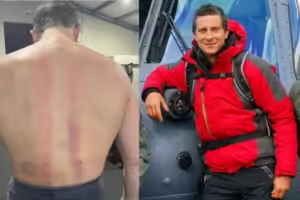
In 1996, Bear Grylls, then 21, jumped from a plane in a routine military skydive over Zambia at almost 16,000 feet. What should have been a controlled descent turned nightmare as his parachute failed to open fully. Hurtling towards the ground with only seconds to react, Grylls crashed onto his back with devastating force.
The impact shattered three vertebrae in his spine.
The doctors were brutally honest: it might be impossible to walk again. His career, his mobility, and his dreams seemed shattered, much like his spine.
Yet in his hospital bed, Grylls refused to give up.
The Agony and the Ascent: A Recovery Beyond Limits
Recovery was grueling. The pain was incessant, sharp, and merciless. Months were spent in confinement, in a state of immobility, and uncertainty regarding the future. Every inch of movement came with agony. But Grylls embraced the suffering as fuel.
He slowly regained movement due to rigorous physiotherapy, relentless determination sharpened by military discipline, and the willpower to carry on. The moment he stepped onto his feet again was more than a medical triumph; it was the rebirth of a warrior.
Despite advice to avoid extreme physical strain, Grylls locked his sights on the impossible: fulfilling the childhood dream he’d been nurturing since age eight.
From Hospital Bed to the Top of the World
Just two years after the accident that almost took his life, Bear Grylls accomplished something incredible.
In 1998, aged just 23, he became the youngest Briton to summit Mount Everest.
His climb was not merely an expedition but a symbol of resilience. Every step on that treacherous mountain echoed his will to rise above pain, fear, and physical limitation. Grylls later admitted that the injuries never fully vanished; chronic pain remains a daily reminder of the fall that changed him forever.
But pain, as he often says, is not a setback – it’s a teacher.
Living Proof of Unstoppable Willpower
Today, Bear Grylls is celebrated not just for survival shows and daring adventures but for embodying the spirit of perseverance. He openly speaks about managing pain through cold therapy, strengthening routines, and mental conditioning.
Grylls makes it clear that adversity is not what defines us. Our response is.
The Bear Grylls parachuting accident is a strong reminder that the harshest moments in life often define the very turns leading to greatness. From a broken spine to the summit of Everest, his tale of adventure is more about the resilience of the human mind, grit, and unyielding pursuit of purpose.
Visit Pakistan Updates for more inspiring stories, news, and developments from around the world.