



An Exit of Apple AI Chief Shake-Up That Sent Shockwaves Through Silicon Valley
In a surprise move that sent shockwaves across the globe’s tech fraternity, Apple announced that John Giannandrea, Senior Vice President of Machine Learning and AI Strategy at the company, will retire early next year. Giannandrea’s exit comes at a very critical juncture for the iPhone manufacturer, which is under immense pressure to prove that it can keep pace with the accelerating revolution in AI.
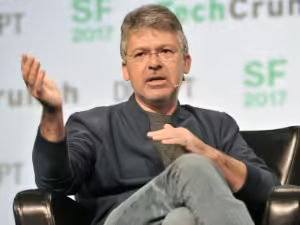
Giannandrea, who arrived at Apple in 2018 after a celebrated stint at Google, was influential in helping to plot Apple’s AI roadmap. His exit, though scheduled, comes amid growing scrutiny over the slower-than-expected rollout of Apple’s next generation of AI features, including a delayed upgraded version of Siri.
He will continue to serve as an advisor for the remainder of his months at the company—a sign that Apple wants a smooth transition during this critical technological shift.
Enter Amar Subramanya: Apple’s New Weapon in the AI Race
To fill the strategic void, Apple appointed Amar Subramanya, an AI veteran highly respected by tech communities, who had spent years in senior positions at Microsoft and Google. Subramanya’s résumé reads like a roadmap of modern AI evolution—he spent 16 years at Google, where he led engineering for the company’s Gemini digital assistant, and later became Corporate Vice President of AI at Microsoft.
Apple has tasked him with leading many “critical areas” including AI foundation models and machine learning, both crucial in powering the next era of Apple Intelligence.
The company said Subramanya’s extensive experience in integrating AI into consumer products would be crucial as Apple ramps up its AI strategy amid increasing competition.
Why Apple Can’t Afford to Fall Behind
For more than a decade, Apple has positioned itself as the leader in innovation, but the pace of rival improvements is rewriting the rules of competition. The rapid-fire release of powerful, ever-improving AI systems by Google, Microsoft, OpenAI, and others has rewritten the competitive dynamics.
Meanwhile, Apple has come under criticism for its cautious approach to AI development and lagging behind in generative AI. The delayed revision of Siri, now scheduled for next year, remains the biggest example of its struggles to keep pace.
But Tim Cook insists that AI remains “central to Apple’s strategy”, and Apple Intelligence is expected to form the backbone of its next generation of products. The appointment of Subramanya—someone deeply entrenched in both consumer AI and foundational model development—only serves to signal Apple’s renewed commitment to reclaiming leadership in this area.
A New Chapter for Apple Intelligence
With Subramanya reporting to Craig Federighi, Apple’s Senior Vice President of Software Engineering, the company is gearing up for a far more aggressive and focused AI expansion. This shift likely marks the beginning of a broader transformation-not just in leadership, but in the overall speed, ambition, and direction of Apple’s AI initiatives.
The coming year may define Apple’s future in a world where AI is no longer a feature, but the platform on which entire digital ecosystems are built.
How Apple addresses these issues will determine whether it can make the transition from playing catch-up to setting the pace once again.
For more stories and updates on global tech shifts, stay connected with Pakistan Updates.