



IMF Pakistan Economic Review 2026: Mission Starts for $1.2bn Tranche
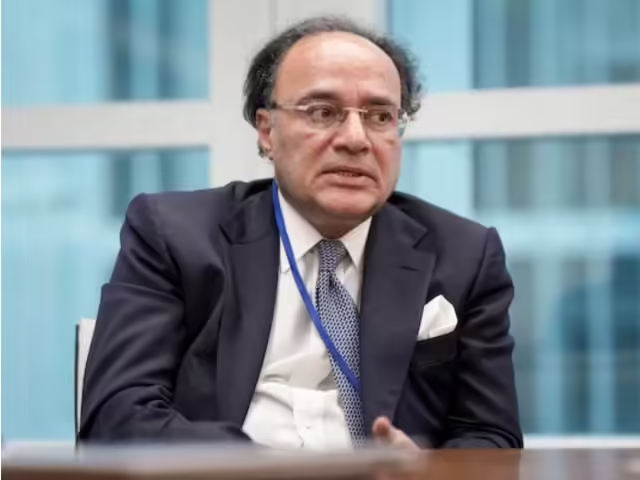
The IMF Pakistan economic review 2026 officially kicked off in Karachi on Wednesday, February 25, 2026. Finance Minister Muhammad Aurangzeb expressed strong confidence in the country’s position as the International Monetary Fund (IMF) mission, led by Iva Petrova, began critical discussions. This review is a pivotal step toward unlocking approximately $1.2 billion in funding, which is essential for maintaining the nation’s economic stability and growth trajectory.
The Scope of the Dual Review
The visiting staff mission is tasked with a dual responsibility. They are conducting the third review under the Extended Fund Facility (EFF) and the second review under the Resilience and Sustainability Facility (RSF). These discussions, scheduled to conclude by March 11, will evaluate Pakistan’s adherence to both performance and structural benchmarks.
Minister Aurangzeb characterized the initial phase of the visit as the start of a “meaningful conversation.” While he noted it is early to predict the final outcomes, he emphasized that the government has worked diligently to meet the agreed-upon targets. If successful, Pakistan expects to receive $1 billion from the EFF and $200 million from the RSF by late April.
Key Economic Indicators and Targets
The IMF Pakistan economic review 2026 comes at a time when several macroeconomic indicators show signs of recovery. The IMF has already acknowledged that Pakistan’s policy measures have helped rebuild international confidence.
Current highlights of the economic framework include:
-
Fiscal Surplus: A primary fiscal surplus of 1.3% of GDP for FY25, meeting program targets.
-
Inflation Outlook: The State Bank projects inflation to stabilize between 5% and 7% for FY26 and FY27.
-
Foreign Reserves: Reserves reached $14.5 billion at the end of FY25, with an ambitious target of $18 billion by June.
[Image showing a trend line of Pakistan’s Foreign Exchange Reserves increasing from 2024 to early 2026]
Critical Discussion Points
The mission will delve into several “thorny” issues that remain central to Pakistan’s long-term sustainability. These include the management of circular debt, recent adjustments in electricity tariffs, and the implementation of the National Fiscal Pact. Furthermore, the IMF team will review the preliminary framework for the FY2026-27 federal budget to ensure it aligns with the debt sustainability goals.
World Bank Collaboration
While the IMF talks were underway, Finance Minister Aurangzeb also met with World Bank Country Director Bolormaa Amgaabazar. Their discussions focused on the Country Partnership Framework (CPF), specifically targeting human capital development, climate resilience, and energy sector reforms. The World Bank reaffirmed its commitment to supporting Pakistan’s provincial and federal governments in enhancing transparency and monitoring mechanisms for development projects.
As the IMF team moves from Karachi to Islamabad for formal talks with federal authorities, the focus remains on ensuring that the reform momentum is not lost. For the average citizen, the successful completion of this review is seen as a necessary step to keep the currency stable and inflation within manageable limits.