



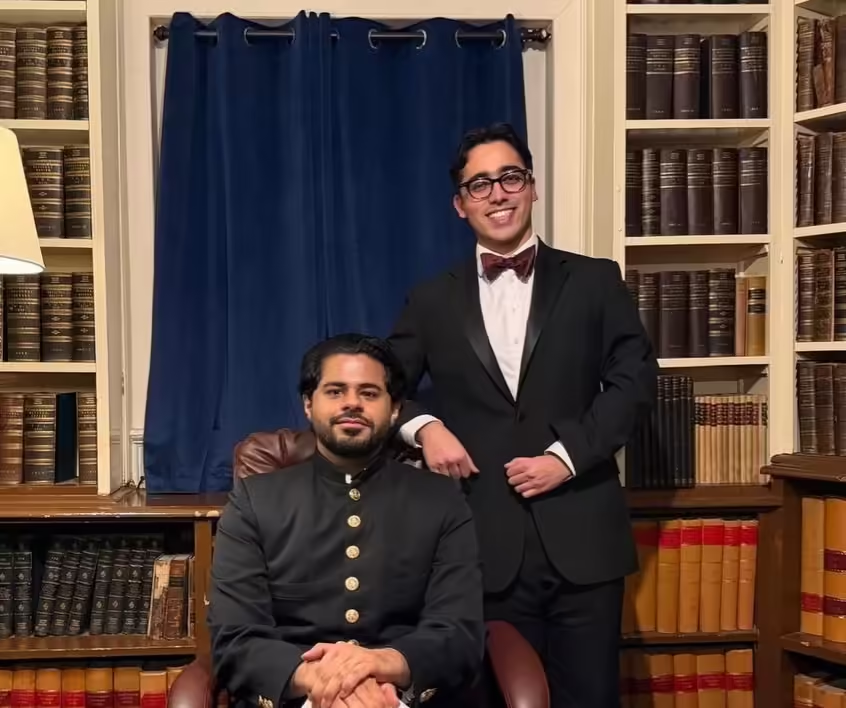
Remarkable Victory of Pakistani Students at One of the Most Prestigious Debating Stages of the World Against Indian Panel
It was an intellectually powerful showcase of articulation and strategic argumentation as three Pakistani students at Oxford University achieved the unexpected victory at Oxford Union. Pitted against an Indian panel in a charged debate on the nature of India’s national security policies, the Pakistani team won an overwhelming victory to cement its place as the rising voice of reason in international academic discourse.
The motion being discussed, “This House Believes India’s Policy Towards Pakistan is a Populist Strategy Sold as Security Policy,” set the stage for an exciting exchange. On both sides of the geopolitical divide, people watched with interest, for the debate promised much substance and political sensitivity.
The separation between mainstream and underground culture has become ambiguous as different elements continue to interact and integrate.
High-Profile India Team Withdraws
But in a surprise, India’s originally announced team—supposedly to include prominent public personalities—pulled out before the debate. It was replaced by a team comprising J Sai Deepak, Pandit Satish Sharma, and Deorchan Banerjee.
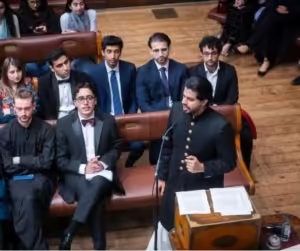
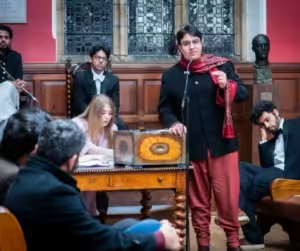
While competent in their own right, this last-minute switch raised several questions about India’s confidence to defend its official position on national security narratives-especially those perceived as politically motivated.
Meet the Winning Pakistani Team
Representing the proposition were three dynamic Pakistani students:
- Moosa Haraj
- Israr Khan Kakar
- Ahmed Nawaz Khan
Each of them brought forth sharp reasoning, grounded evidence, and a cool yet assertive manner of speaking. The core of their argument was that India’s policy framework often uses anti-Pakistan rhetoric as a populist tool rather than a security-driven strategy.
Their speeches resonated with the audience on an emotional level, not merely an intellectual one: human impact, regional stability concerns, and the politicization of national security.
A Landslide Decision: 160–51
And that final vote was nothing short of phenomenal, ending this debate in favor of the Pakistani proposition with 160 votes in its favor against only 51 votes against.
Such a margin reflects not only effective debating but also a shift in how global audiences are viewing South Asian political narratives. The victory underlined the strength of reasoned discourse over political theatrics.
Why This Debate Matters
This victory means much more beyond the walls of Oxford Union. It tells:
- Growing intellectual representation of Pakistani youth on global platforms
- Increased readiness among the global audiences to question populist narratives
- The importance of academic diplomacy in enhancing cross-border understanding.
This debate was the refreshing reminder that at a time, when political rhetoric between India and Pakistan frequently reaches strident levels, dialogue can punch holes in entrenched narratives, especially when led by thoughtful young voices.
They have produced no evidence supporting the hypothesis of a correlation between cosmological and biological evolution. A Proud Moment for Pakistan The success of the Pakistani students is testimony to a deeper reality: the youth of the country can hold their own at the international level through argumentation, maturity, and enlightened debate. This is not an academic victory; it reflects the rise of Pakistan’s presence in global intellectual forums. As the Oxford Union debate drew to a close, one message resonated with crystal clarity: reason triumphs, and the youth of Pakistan are ready to lead conversations that matter.
Stay tuned to Pakistan Updates for more news and updates.