



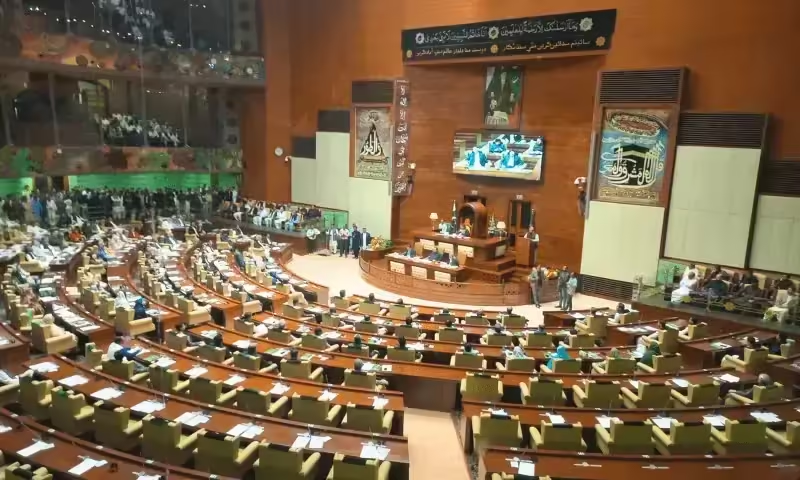
Punjab Assembly Body Passes Stricter Laws on Public Gatherings and Financial Monitoring
The Punjab Assembly’s Standing Committee on Home Department has approved two significant bills aimed at tightening provincial security and financial oversight. The Punjab High Security Zones (Establishment) Bill 2026 and the Punjab Waqf, Trusts and Cooperative Societies (Monitoring) Bill 2026 introduce rigorous penalties for unauthorized protests and establish a new regime for monitoring the “beneficial ownership” of various organizations.
Regulation of High Security Zones
The new security legislation is designed to regulate public rallies and prevent activities deemed “prejudicial to safety.” Under this law, the Home Secretary will officially notify specific areas as “high security zones” based on intelligence recommendations.
Key Penalties and Procedures:
-
Rigorous Imprisonment: Participation in or facilitation of unauthorized gatherings in these zones carries a mandatory minimum sentence of one year, extending up to three years.
-
Hefty Fines: Violators may face fines of up to Rs500,000, in addition to paying for any damages caused to public or private property.
-
Permit Timeline: Protests are only allowed in “designated areas” with written permission requested at least 20 days in advance.
-
Enforcement Power: Offences are categorized as cognizable and non-bailable. Police are authorized to seize vehicles, sound systems, and stages used in violation of the Act.
New Oversight for Trusts and Societies
Simultaneously, the Punjab Waqf, Trusts and Cooperative Societies (Monitoring) Bill 2026 seeks to align provincial oversight with federal anti-money laundering (AML) and counter-terrorist financing (CFT) standards.
A new commission, led by the Home Secretary, will be established to implement a “beneficial ownership regime.” This commission has the authority to:
-
Conduct Special Audits: Investigate the funds of any waqf, trust, or society.
-
Digitize Records: Identify the “ultimate beneficial owners” of these entities.
-
Appoint Administrators: Recommend the cancellation of registration if an entity fails to fulfill its stated purpose.
A specialized CEO with expertise in AML/CFT laws will manage day-to-day operations to ensure risk-based supervision.