



India Israel Strategic Partnership 2026: Impact on Pakistan Security
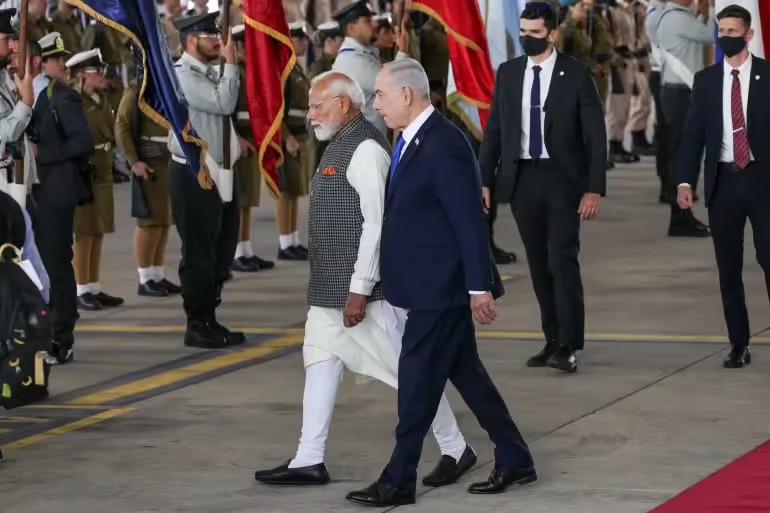
The geopolitical landscape of South Asia and the Middle East has shifted following Indian Prime Minister Narendra Modi’s landmark visit to Tel Aviv on February 25, 2026. This second visit—the first by an Indian premier since 2017—marks a deepening of the India Israel strategic partnership 2026. For Pakistan, this tightening embrace between New Delhi and Tel Aviv presents a multifaceted challenge to its national security and diplomatic standing.
The “Hexagon of Alliances” and the Sunni Axis
During the visit, Israeli Prime Minister Benjamin Netanyahu proposed a “Hexagon of Alliances.” This regional framework places India at the center, alongside Greece, Cyprus, and various Arab and African states. Netanyahu explicitly stated the goal is to counter “radical axes,” including what he termed an “emerging radical Sunni axis.”
Analysts suggest this “Sunni axis” likely refers to the growing security bloc between Pakistan, Saudi Arabia, and Turkiye. Following the Pakistan-Saudi Strategic Mutual Defence Agreement signed in September 2025, Israel appears to be viewing Islamabad’s military ties with Riyadh and Ankara with increasing suspicion.
Advanced Military Technology Transfers
The military dimension of the India Israel strategic partnership 2026 is perhaps the most immediate concern for Islamabad. India remains Israel’s largest arms purchaser, but the new “classified framework” discussed this week takes the relationship further. Key defense highlights include:
-
Iron Beam Laser System: Discussion regarding the export of Israel’s 100kW-class high-energy laser weapon to India.
-
Drone Warfare: Increased cooperation following the effective use of Israeli-origin drones during the 4-day aerial war between India and Pakistan in May 2025.
-
Artificial Intelligence & Cyber: Collaborative efforts in AI-driven battlefield management and advanced cybersecurity protocols.
Intelligence Sharing: RAW and Mossad
Former Pakistani diplomats have raised alarms over the formalization of intelligence sharing. While links between India’s RAW and Israel’s Mossad date back decades, the 2026 visit is expected to result in a “special strategic agreement.” This pact would likely mirror Israel’s deep-security ties with the U.S. and Germany, potentially leading to real-time intelligence sharing regarding Pakistan’s nuclear program and counter-terrorism operations.
“Intelligence sharing between RAW and Mossad should be of serious concern for us,” noted former Ambassador Masood Khalid.
Pakistan’s Diplomatic Counter-Strategy
In response to this shifting alignment, Pakistan is focusing on “Geoeconomics.” By strengthening ties with the Gulf Cooperation Council (GCC) and Central Asian republics, Islamabad aims to offset Indian influence through trade and connectivity.
[Image showing the comparison of defense spending and technology acquisition between India and Pakistan in 2026]
However, the balancing act is delicate. With the UAE signing its own strategic agreement with India in January 2026, Pakistan must navigate a region where its traditional allies are increasingly engaging with its primary rival. The tightening India Israel strategic partnership 2026 ensures that the “strategic calculus” in Islamabad will remain under constant pressure for the foreseeable future.