



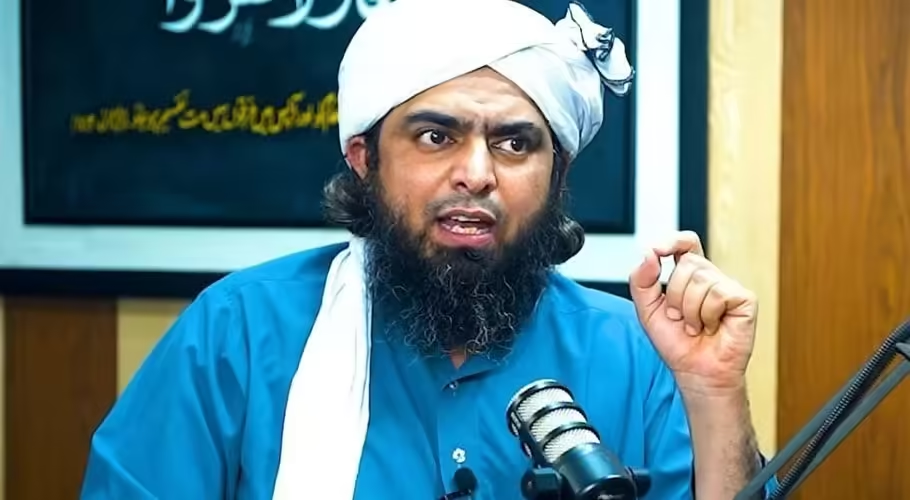
Engineer Muhammad Ali Mirza praises Punjab Government For Safety Measures on Basant
For decades Pakistan’s cultural fabric has been interwoven with kite flying. Particularly for youngsters raised in small homes, it represented happiness, inventiveness, and good competition across generations. Engineer Muhammad Ali Mirza lately pondered this yearning, remembering a period when families would purchase basic doors and kites themselves, generating delight without extravagance. Millions of people who relate kite flying with innocence, liberty, and common festivity agreed with his ideas.
Under bright skies, this cultural activity was never only a game; it was an emotional journey that linked communities, rooftops, and even cities.
Emotional Influence of the Kite Flying Prohibition
The prohibition of kite flying in Pakistan has remained a very emotionally charged topic. According to Engineer Muhammad Ali Mirza, absolutely outlawing kites seems like removing a component of national identity. He underlined that categorizing cultural activities as immoral or illegal establishes a troubling precedent. His comments mirrored general public opinion: Today it’s kite flying; tomorrow another sport or festival could suffer the same penalties.
This issue brings up the fine equilibrium between cultural preservation and legislation, one that calls for careful governance instead of complete restrictions.
Distinguishing Danger from Culture
The difference between kite flying itself and the risks brought by chemically coated string was a major argument Engineer Muhammad Ali Mirza made. He agreed that the true danger stems not from the activity but from dangerous behaviors that have led to horrific accidents over the decades.
He pushed for smart regulation rather than outlawing the game. Targeting the underlying cause—chemical thread—the government can save lives without destroying enjoyment. This viewpoint fits public demand for safety-driven policies rather than emotionally disconnected prohibitions.
Safety Policies and Government Initiatives
Engineer Muhammad Ali Mirza enthusiastically said he was hopeful regarding recent government initiatives. He pointed out that chemical string has been outlawed and that preventive steps are being carried out. Installing protective rods on almost ten lakh motorcycles to lower the risk of kite string damage during holiday seasons is one important step.
Such actions show that tradition and safety may coexist. Correct enforcement, awareness campaigns, and accountability can turn a dangerous surroundings into a controlled and joyful one.
Festivals, faith, and freedom
Engineer Muhammad Ali Mirza also brought up a larger problem: the increasing propensity to interpret cultural events using inflexible moral lenses. He cited how identifying holidays or sports as religiously unacceptable might split society and stifle group happiness. His reference to “the festival of English” represented freedom of expression and the pleasure of celebration beyond strict limits.
His message was clear: culture and faith ought to support life, not limit innocent happiness.
Request for Fair Governance
Fundamentally, Engineer Muhammad Ali Mirza’s comments were a call for equilibrium rather than a protest. While fiercely against cultural erasure, he backed responsibility, safety, and regulation. Managed correctly, kite flying can still be a source of national pride instead of conflict.
The public reaction to his words mirrors a common want: a Pakistan in which customs are preserved, lives are safe, and delight is not forbidden.
Visit Pakistan Updates for more perceptive news and reports.