




Pakistan Scales New Heights: The Successful Launch of EO-2 Satellite
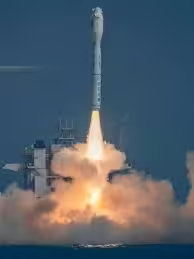
In monumental leap for its national space program, Pakistan successfully launched its second indigenous Earth Observation Satellite, EO-2, on Thursday, February 12, 2026. The satellite was deployed into orbit using a Smart Dragon-3 (SD-3) carrier rocket from the Yangjiang Seashore Launch Centre in China. This milestone, coming exactly one year after the launch of its predecessor EO-1, solidifies Pakistan’s position as a rising player in advanced satellite technology and self-reliance.
Strategic Capabilities of EO-2
Developed entirely by the Space and Upper Atmosphere Research Commission (SUPARCO) at its Satellite Research and Development Centre, the EO-2 is a high-resolution electro-optical imaging powerhouse. Its primary functions include:
Precision Mapping: High-resolution imaging for urban expansion and infrastructure tracking.
Natural Resource Management: Monitoring water resources, agricultural health, and forestry.
Disaster Resilience: Providing real-time, accurate data for flood assessment, climate analysis, and rapid emergency response.
National Governance: Supporting strategic decision-making through timely geospatial intelligence.
The “Dual-Satellite” Advantage
EO-2 will work alongside EO-1 to improve data capture. By operating together, these two satellites provide:
Improved Continuity: More frequent passes over the same geographical areas.
Varied Illumination: The ability to observe Earth under different lighting conditions for better feature interpretation.
Enhanced Coverage: A broader and more precise dataset for long-term environmental monitoring.
2026: A Year of “Firsts” for Pakistan in Space
The EO-2 launch is part of a broader, accelerated space strategy. Just days ago, on February 7, 2026, the nation reached another turning point:
Two Pakistani candidates were officially shortlisted by the Astronauts Centre of China (ACC).
-
The Mission: After six months of rigorous training, one of these individuals will be selected to travel to the Tiangong Space Station in late 2026.
-
Global First: Pakistan will become the first foreign partner to have an astronaut reside aboard China’s space station, serving as a payload specialist.
Leadership Perspectives
“This success reflects our growing technological footprint and the enduring Pakistan-China strategic partnership, which is now transcending into space.” — Prime Minister Shehbaz Sharif
“EO-2 reflects our steady progress toward technological self-reliance. I commend our scientists and engineers for expanding our indigenous space infrastructure.” — Deputy PM Ishaq Dar