



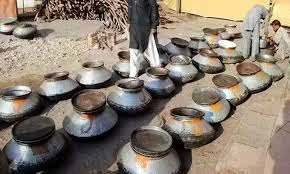
Punjab takes the first step for simpler, kinder funeral traditions – Put ban on food at funerals
In what can be viewed as an attempt at reshaping deep-seated social customs, the Punjab Government has announced a province-wide ban on preparing and serving food at funerals. Seen as a considered attempt to take the financial and emotional load off families already dealing with loss, the change comes after years of funeral feasts drifting from optional acts of care into rigid expectations that weigh on mourners.
Through this ban, the authorities indicate that a line is being drawn to distinguish cultural excess from real values related to the culture of sympathy and mutual help, especially in needy families.
Why this ban makes sense
Officials indicate that many families are put under social compulsion to feed large numbers of mourners during burial days and meetings of condoning. In many cases, these arrangements contribute to either borrowing money or falling into debt, an outcome totally in conflict with the compassion the moment calls for.
According to the order, cooking, catering, and distribution of food at funerals and other condolence ceremonies will be banned. The district administrations will enforce the policy while public awareness campaigns will be held to explain the purpose of the policy. Rather than relying on punishment, authorities hope to foster voluntary compliance through understanding and community acceptance.
Religious point of view: simplicity, not display
A key element of broad public support is its alignment with Islamic teachings. Religious scholars underscore that Islam favors simplicity in funeral rites and that neighbors and relatives share the responsibility of supporting the bereaved rather than burdening them with costly hospitality.
Many clerics have welcomed the ban, pointing out that feeding mourners is not a religious duty but a cultural custom that has grown over time. Looked at this way, the Punjab ban on food at funerals is seen as a return to core religious values of compassion and dignity.
Public reaction: praise grows even as practical questions arise
Responses online and in public discussions have been mostly positive; activists and everyday citizens alike hailed the move as well-overdue reform. People shared personal experiences of financial strain tied to funerals, underscoring how change was needed.
Still, questions linger over enforcement, particularly in rural areas where traditions tend to run deep and social norms shift more slowly. Critics caution that without regular monitoring and community outreach, compliance might prove spotty.
A change in culture in the making
Yet, the Punjab Government remains optimistic. As one official commented, meaningful cultural change takes time, and a gradual acceptance will follow once families feel the immediate relief this policy brings. Once the necessity to host meals is eliminated, funerals can become a time for quiet contemplation, prayer, and emotional support rather than financial distress.
The ban touches also on wider issues, such as food waste and social inequality, serving to remind people that dignity in grief should not have a price tag.
What the Punjab ban on food at funerals does is more than an administrative fiat; it speaks to a rising realization that some of the strongest social customs are often the most harming to those they seek to comfort. If implemented in practice as well, this could become a model for other regions in the search to effectively balance tradition with compassion. In the long run, it may enable the policy to restore the true essence of communal support: to make the family feel that it is surrounded by people with empathy and not expectations during the most vulnerable moments.
For more news and updates, please visit the Pakistan Updates.