



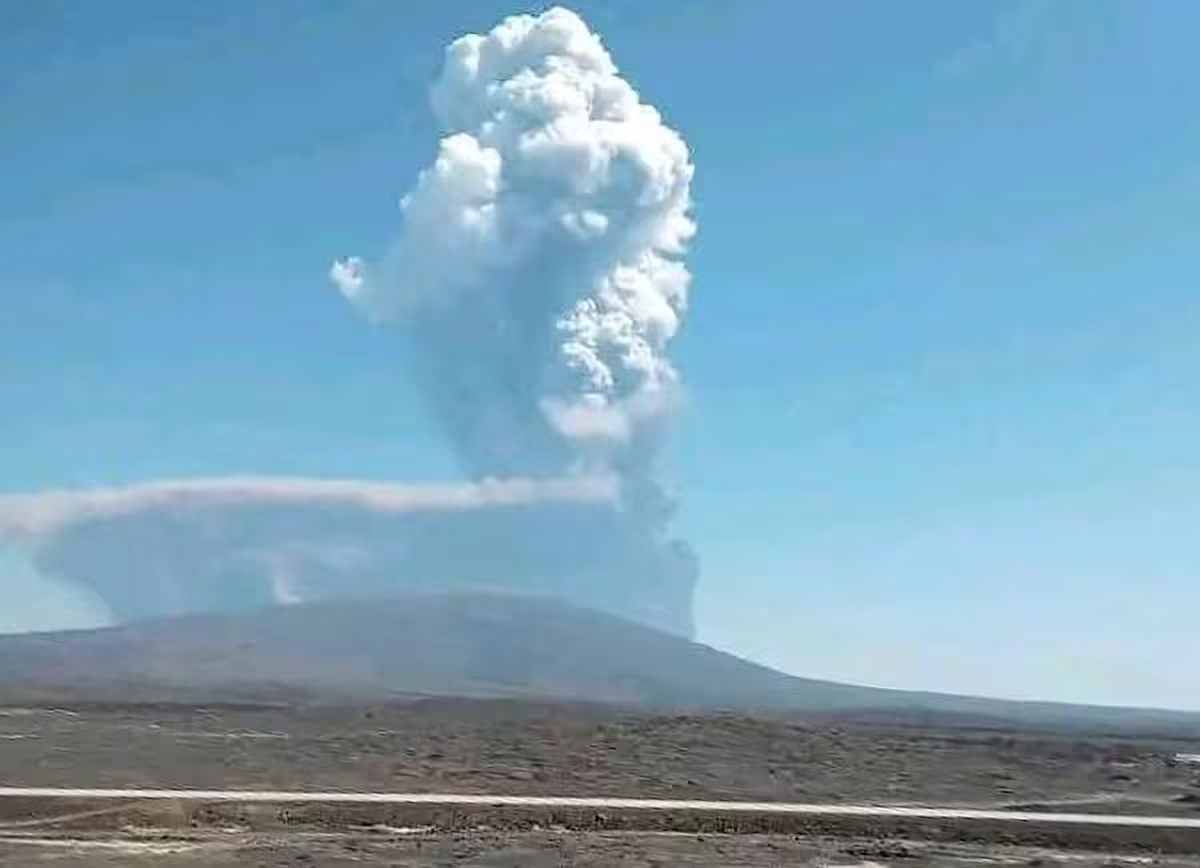
Ethiopia’s Afar Volcano has erupted for the first time in nearly 12,000 years
Nature has yet again shown the world its raw, unpredictable power. In a dramatic, historic event, a volcano in Ethiopia’s Afar region has erupted for the first time in nearly 12,000 years, surprising geologists and capturing global attention. The eruption has thrust the Afar depression-one of the most geologically active regions on Earth-into the spotlight, offering a rare yet powerful look into the forces shaping our planet beneath its surface.
A Towering Plume Visible from the Entire Region
The Afar volcano eruption spewed enormous plumes of ash and smoke, shooting up to 14 kilometers into the air. This tall column was visible from miles away, as the eruption painted the sky with an ominous blend of grey and charcoal. Such large-scale vertical dispersal of ash is usually characteristic of highly explosive eruptions-an indication of just how serious this geological event really is.
To scientists, this is more than a show; it’s a discovery. Afar actually sits atop the East African Rift Valley, where three tectonic plates are slowly pulling apart from one another. Although small seismic activity is very common, a major eruption like this one hasn’t been recorded in thousands of years—making it a once-in-millennia scientific phenomenon.
Ash Cloud Drifts Toward Pakistan – But No Major Impact Expected
The Pakistan Meteorological Department (PMD) said the ash cloud has started to drift toward parts of Yemen, Oman, India, and northern Pakistan because of the wind pattern in the upper atmosphere. As this initially sounded alarming, experts explained that the concentration of ash is actually too low to bring about any major disruption.
More importantly, southern Pakistan, which includes Karachi, is not expected to be impacted. Flights, daily routines, and quality of air remain unaffected, though the officials remained alert. The PMD continues tracking the ash plume across regional air corridors, continuing to provide warnings well in advance if a shift happens.
A Reminder of Earth’s Restless Heartbeat
The eruption of the Afar volcano is more than a transient natural wonder; it’s a reminder that the Earth is in constant turmoil from within. Rare in the world, the Rift Valley is a place where one can see continents actually pull apart. Over a period of many millions of years, Africa itself is slowly splitting into two landmasses, and this eruption serves as a dramatic punctuation mark in that slow-motion tectonic process.
Although the eruption poses limited danger in Pakistan, it underlines how interconnected global weather systems, air travel routes, and atmospheric circulation have become. Events unfolding several thousand kilometers away can, in hours, influence skies and air quality over South Asia.
Governments and Scientists on High Alert
The regional authorities and agencies monitoring volcanoes have thus swung into action. Satellite systems track ash density, operators of flights have been warned, and the meteorological departments in Asia and the Middle East are coordinating on the possible fallout. Thus, for the time being, everything is under control-but research teams are frantically analyzing this data, trying to understand the volcanic behavior of the Afar region.
In a world conditioned to man-made noises, the voice of nature, deep and powerful and ancient, spoke volumes in the Afar volcano eruption. As the ash settles and analysts complete further assessments, one thing is clear: Earth still holds mysteries capable of overwhelming even the most advanced technologies and predictions.
Stay connected with Pakistan Updates, your trusted source for accurate, timely, and impactful news.