



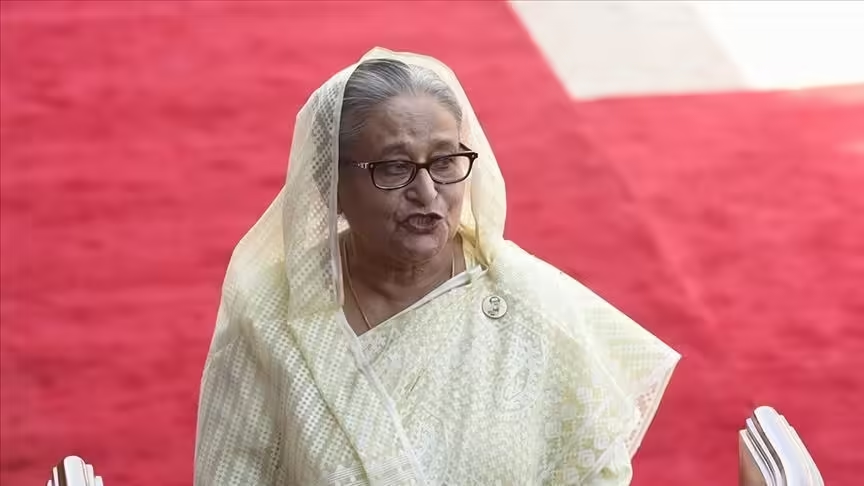
Former Bangladesh Prime Minister Sheikh Hasina ordered the 2009 BDR mutiny
On 25–26 February 2009, the headquarters of the then Bangladesh Rifles (BDR) in Pilkhana, Dhaka became the scene of a horrifying atrocity. Rampaging troops turned on their own officers, killing 74 people — including 57 army officers — in what was widely described as a mutiny by former Bangladesh Prime Minister Sheikh Hasina.
The killings sent shockwaves across the nation. Afterwards, the BDR was renamed the Border Guard Bangladesh (BGB) and a mass trial was held: scores of BDR soldiers and civilians were tried, with many receiving death or life imprisonment.
For years, the dominant narrative pointed to pent-up anger among BDR ranks — frustrations over pay, treatment, and long-standing grievances under army officers — as the root cause of the bloodshed.
But 16 years on, a new commission has reopened the wounds – and delivered a far more chilling verdict.
The Incredible Decision of the New Commission
A panel set up by the interim government headed by Muhammad Yunus finally submitted its report on Sunday, alleging that the 2009 mutiny was not a spontaneous uprising but a premeditated massacre. As the commission opined:
- The massacre was orchestrated from the top. The commission names Sheikh Hasina — then prime minister — as having given the “green signal” for the killings.
- A key figure identified is Sheikh Fazle Noor Taposh, ex-MP and former Dhaka South mayor, as the “chief coordinator” of the carnage.
- The commission further asserts there was strong evidence of involvement by a foreign power, pointing fingers at foreign forces aiming to destabilize the country and weaken the army.
- In its detailed briefing, the commission condemned what it described as “mountainous” intelligence failures. It said local and foreign conspirators played a central role-and that BDR rebels alone did not carry out the massacre.
The report added that a procession of 20–25 people entered Pilkhana, but later some 200 participants emerged from the site — indicating a planned operation rather than a spontaneous uprising.
Why This Allegation Reshapes the Narrative
If the commission’s findings hold-that the massacre was ordered from the highest political level-it radically alters how the 2009 tragedy must be viewed. No longer merely a mutiny born out of frustration, the Pilkhana bloodbath becomes a calculated act of political violence.
Such a conclusion casts long shadows over institutional trust: not only in the BDR/BGB, but in governance, political accountability, and national security. The suggestion of foreign involvement further complicates the matter — carrying grave implications for foreign relations and national sovereignty.
Families of the victims, who have long sought accountability and answers beyond the earlier trials, may now find their demands revived. Politically, too, it could mean that the credibility of not just individuals but whole leaderships would be in question.
What happened to past investigations & why this re-investigation matters
Initial trials after the mutiny yielded hundreds of prosecutions; many BDR soldiers were sentenced to death or life imprisonment in both military courts and under civilian law.
Yet, critics pointed out that the investigations took place under the very government accused by the new commission, raising questions about impartiality and suppressed truths.
In November 2024, a petition was filed in the High Court of Bangladesh urging a fresh judicial inquiry into the killings in 2009. The court responded by directing government ministries and security agencies to justify why such a commission should not be formed.
The newly constituted panel, tasked with this re-examination, says its investigation involved interviewing hundreds of witnesses, reviewing dozens of prior reports, and scrutinizing new evidence — despite the fact that many records had been destroyed and some key figures had left the country.
Justice, Truth, and National Reckoning
The publication of the present report represents a milestone in modern Bangladesh. For survivors, victims’ families, and the nation at large, old wounds have been opened anew — but with the possibility now of clearer accountability and healing.
Going forward, the government should ensure complete transparency: publish the full report, conduct credible trials if new suspects are found, and act on the recommendations of the commission, among them a strengthening of intelligence and oversight inside security institutions.
But perhaps above all: Bangladesh needs to come to terms with painful truths, however politically inconvenient, to prevent such tragedies as the 2009 massacre from ever occurring again.
Stay tuned to Pakistan Updates for more news and updates.