



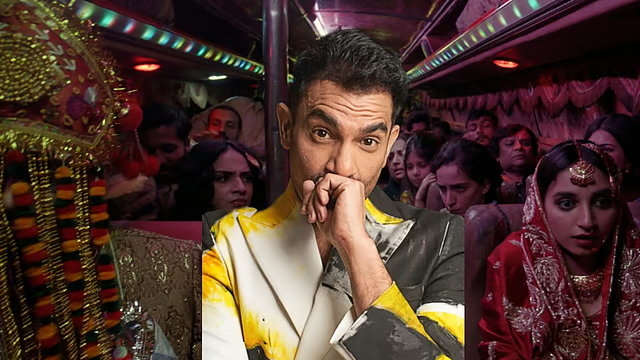
Pakistani Director and Filmmaker Sarmad Sultan Khoosat Lali rising the level of Pakistan Cinema at Berlin International Film Festival
Lali just made history for Pakistani cinema, and honestly, it’s about time. Sarmad Sultan Khoosat, one of the country’s boldest directors, brought his latest film, Lali, to the Berlin International Film Festival—right into the Panorama section. This isn’t just a nod; it’s Pakistan’s first fully homegrown production to land at Berlinale, and that’s a big deal.
But Lali doesn’t settle for safe storytelling or easy labels. The film dives deep, mixing psychological drama with themes that hit close to home—desire, masculinity, and that old baggage families pass down. It’s rooted in Pakistani culture but speaks to everyone, everywhere.
At the center of the story, you’ve got Zeba and Sajawal, a newly married couple whose relationship isn’t as simple as it first seems. Zeba comes with a heavy past—she’s lost three fiancés before they even made it to the wedding. People whisper about a curse, and the tension follows her into this new marriage. But Khoosat isn’t interested in cheap scares. He uses the idea of a curse to dig into bigger fears—fragile egos, anxious minds, and the stuff men are trained to hide. The real horror isn’t ghosts or superstition; it’s the pressure simmering between two people trying to live up to everyone else’s expectations.
Desire in Lali isn’t just about love or lust. It’s complicated, shaped by tradition, old wounds, and the weight of what a man “should” be. Sajawal fear isn’t really about curses at all; it’s about the crushing need to prove himself. Meanwhile, Zeba stands at the edge—she’s wanted, but she’s also seen as dangerous. She’s caught in a system that blames women for men’s failures, and Khoosat doesn’t shy away from showing that. The film swings between heat and chill, pulling the audience through moments that burn with intensity and then drop into uneasy quiet.
Mamya Shajaffar and Channan Hanif carry the whole thing. Mamya Zeba isn’t just a victim or a femme fatale—she’s complicated, strong, and hard to pin down. Channan gives Sajawal a nervous energy that feels real, letting his fear slip through in small ways. When they’re together, you never quite know what’s going to happen next, and that’s exactly the point.
Khoosat has never been afraid to shake things up, and with Lali, he goes all in. The movie looks gorgeous, but there’s always a sense of something pressing in—a tight space, a glance that lingers too long. He’s not just telling a story; he’s pushing at the boundaries of what Pakistani films can do.
Before the film’s premiere, Khoosat talked about why he lets *Lali* shift so much in tone. Life isn’t smooth or predictable, he said. It swerves, and sometimes it crashes. He also shared that he always thinks of his mother watching his films, building this kind of alternate audience in his mind. That mix—taking risks but staying honest—makes *Lali* feel personal, bold, and unlike anything else coming out of Pakistan right now.
Generational Trauma as a Silent Character
Lali isn’t just about ghosts or old superstitions. Underneath it all, the film digs into generational trauma—the kind that sits quietly in the background but shapes everything. The ghosts aren’t just there for scares; they show all the fears and anxieties families quietly hand down, one generation to the next.
Marriage, in this story, isn’t just a ceremony. It’s where all those old worries come bubbling up. Sajawal’s fear isn’t just his own—it’s soaked in the stories he’s heard about what it means to be a man, about strength and weakness. Zeba’s situation feels familiar too. She carries the weight women have always been expected to bear—honor, blame, even bad luck.
Khoosat nails this invisible inheritance. The whole film feels heavy, almost like the past is a thick fog nobody can really escape.
A New Chapter for Pakistani Storytelling
Lali showing up at the Berlin Film Festival? That’s huge. It’s not just about getting noticed overseas. It means Pakistani cinema is finally leaning into tough, complicated stories and not watering them down.
The Panorama section at Berlin is known for taking risks. Lali fits right in. It’s strange but real, unsettling but honest. It doesn’t hand out easy answers or tidy endings. Instead, it pushes people to sit with their own discomfort.
For Pakistan’s film scene, this is a big deal. It shows that local movies can stand toe-to-toe with international ones and still feel totally rooted in their own world.
The Pulse of Lali
Lali doesn’t just tell you a story—it pulls you into it. One minute, there’s a jolt of desire, the next, you’re hit with a sense of dread. The film lives right in that space between longing and fear, and it never lets you get comfortable.
As Sarmad Sultan Khoosat latest film kicks off at the Berlinale, it’s clear he’s not afraid to dig into the messier sides of love and fear. By weaving together tension and intimacy, Lali stands out as one of the boldest, most intriguing films to come out of Pakistan lately.
For news on more international premieres and the latest in Pakistani cinema, keep an eye on Pakistan Updates.